The Contradiction of the Waterfall
2/19/2016
"I was mesmerized, as I always am, by the contradiction of a [waterfall]: an always-moving flow whose shape is ever-constant. A thing at once speeding and still."  A thing at once speeding and still. Eaton Canyon Waterfall, San Gabriel Mountains. In nature as in life, we often appear static. At any given moment our jobs, our friends, our finances, our homes, our entire existence can seem to others, and feel to us, as immovable. But that's never really the case--underneath the shell we are a roaring rapid of constant change. Every friendly conversation, every new idea gleaned, every experienced moment, an opportunity for growth.
In nature as in life, nothing and no one is as simple as they seem... thankfully, because it would be pretty boring otherwise. Attempted Sanity in the Digital Age
2/12/2016
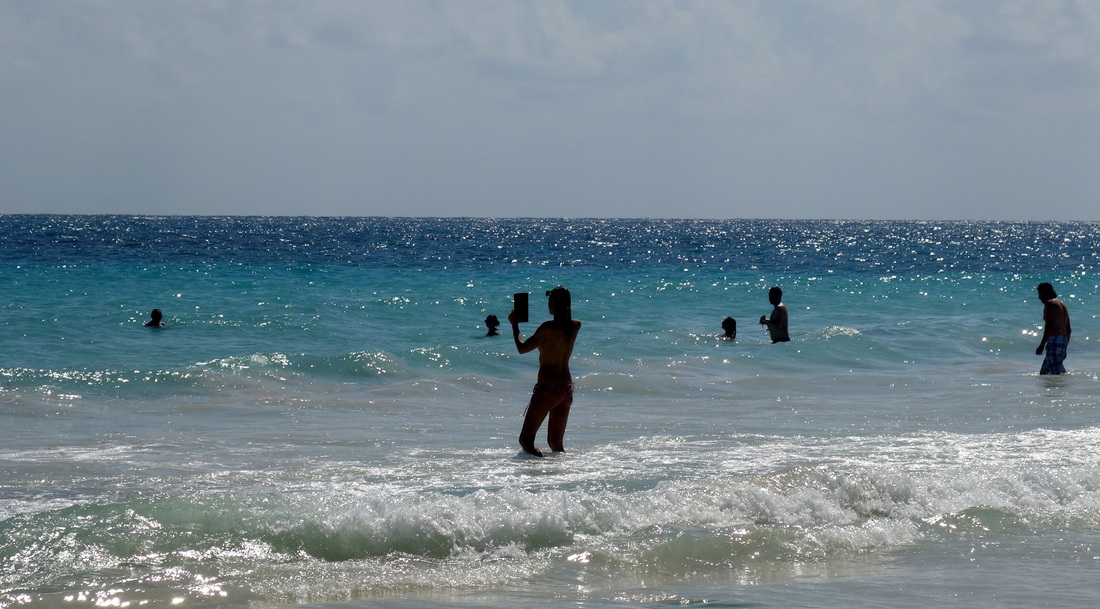 selfies from paradise The heart of this blog is about navigating the complicated waters of our modern times. Yeah, mindfulness is in the title, and sure, I write a lot about nature and hiking and travel, but those things are just methods -- important methods -- I think we all need in order to thrive in this day and age.
The key question I like to ask then is: how do we do that? How do we thrive when there so much digital distraction out there trying to hold us back? The ability to succeed in life, to me, is centered around two distinct yet interconnected sociological arenas. One is our personal world, the life that only we know about because it takes place in our own mind. The other is the social world, the life we show everyone around us. Both feed into one another. Both are fundamental. Our society, social structure, and the way we process and understand it, was developed over centuries. We figured out all sorts of ways to deal with one another. Time, experience, and technology then alter the paradigm and advance us forward. That progress. So it's impossible not to imagine the digital age having some effect on us. I was born around the time some experts deem the start of the millennial generation, but just barely. That means I do remember life before technology, but I also saw the transition start early on. The first time I remember noticing a computer in my daily life was around the 2nd grade, and it grew from there. It started with a few computers in the school office, then a computer lab, then a computer in every classroom, then a computer in every home. Later it became a computer for every person, then a computer and a phone, then a computer and a smartphone and a tablet and a Google and an iTunes and a Netflix and everything you could possibly imagine at your fingertips. These were all fun new gadgets that set out to make life easier, and they did. But in a broader sense they were quickly changing us on a much deeper level. They rapidly progressed a shift in our collective societal mindset, where all the ways in which we communicated went from a naturally sluggish human pace to a modern frenetic digital pace. Let’s take a brief trip through the past then... At one point in time we would make a plan to have dinner with a friend, and there might not be any other moment of communication between the plan and the dinner. There were no direct messages in the interim. No keeping up through Facebook posts. No texts at the last minute to let your friend know you're running late, even though that tardiness was of your own creation. You just met there for dinner, and then you caught up. It was slow and cumbersome, but it was real. I pretty sure this is the way people used to make plans because I’ve seen it in the movies. At one point in time we were slowly introduced to a new friend over time. We met at a party, got together over coffee, talked on the phone from time to time, and maybe got together with mutual friends. It took time and you had to put in effort. There was no method, beyond a private investigator, to dig into someone's past other than to simply ask them. There was no Facebook or Twitter history to explore. I believe I vaguely recall a life like this, sometime before Friendster and the subsequent onslaught and exposure of our personal world onto public mediums. At one point jealousy totally existed, sneaking into our psyche, causing us to covet the experiences of others. We would regret the decision to break up with that one guy or quit that one class. Worry was ubiquitous as we went about our day, and especially after the evening news of an episode of “Unsolved Mysteries”. All these emotions existed, but they took time to evolve. We weren't unavoidably reminded of the things we should fear and things we were missing out on via social media. I remember feeling all these emotions from time to time, but not as much as I do now. At one point gossip and cruelty were a part of our social world. People have always talked behind other's backs and there were always mean girls and mean guys. But you had to be mean face to face. You couldn't sulk and hide behind a digital avatar as you spit venom while claiming victimhood. I know assholes existed in the past because I did everything I could to avoid them. They’re not as easy to avoid nowadays. Our modern digital age has sped up the typical human socialization process, making it much easier to jump into these age old emotions. It facilitates and encourages laziness, impatience, jealousy, and cruelty by placing a rapid succession of updates in an easily accessible newsfeed. It leaves the normal pattern of social graces by the wayside. It discourages living in the present because this ability we now have to keep in touch so easily, is so easily addictive. And before you troll me with a “get off my lawn!” comment, I’m not saying the digital age is a bad thing. Information and communication is at our fingertips, and those are two key elements to thriving in life. What I’m saying is that the changes the digital age has so quickly foisted upon us demands our careful attention. The more we breeze through life without consideration, the easier it is to fall into the traps of jealousy and insensitivity towards our fellow man. We can live in the digital age and still take with us a reminder of the way things were. And really, all that is is being mindful. That’s how we maintain our sanity in the digital age. That's what this blog is about. The Phone Productivity Myth
1/6/2016
 The other day I spent some time on my phone.
I took a few minutes updating my reminders and to-do list...it's a busy time of year. I scrolled through Facebook and Instagram, a like here and a like there...keeping up with friends. I checked how many steps I had taken that day...exercise is key. For a second there I felt productive, but then I realized, I hadn't really done anything at all. Updating a to-do might tell me what I need to get done, but it doesn't mean I'll actually do it. Liking a post on Facebook might remind friends I exist, but that's not actually keeping in touch. Keeping track of how many steps I took gives me a calorie count, but rarely does it encourage me to walk more. During the time I spent on my phone I could have worked on a project, gotten lunch with a friend, or gone on a hike, actually achieving the things I pretended I was achieving with my phone. There's motivation to be found on our modern devices for sure, but don't let it fool you into reliance. Get off your ass and do real things. Real things are how you really move forward. New Years Reflection and Expectation
12/30/2015
 reflection//yosemite It's New Years, which means it's that time when everyone comes up with their year-end reviews, top ten lists, and judgements on their personal successes and failures of the past year. There's both good and bad in that. Reflecting back on your life can be a healthy exercise, but it can also be a precarious game that will easily drag you away from mindfulness. Like most opportunities in life, it really depends on how you use it. When you're looking back on the past year as an exercise in renewal, you have two options: Option #1: reflect on both the ups and downs of the past year, take from them the life lessons they extol, and use this new found inspiration to make the next year a better one. or Option #2: reflect mostly on the downs of the past year, regret them, curse them, use them as an example of why the past year was terrible, and then believe that engaging in this exasperated act of faux reflection will somehow make the next year a better one. I would say the choice is pretty obvious, but that’s just me. Maybe I'm just perpetually hopeful, but I've never been disappointed in a year. Sure I’ve had intensely difficult times in my life making certain years seem better than others, but even in those bad years there has always been love. There has always been light to be found somewhere in the darkness. Things always eventually get better, so I always expect them to. I also believe that reflection is something we could be doing every day of our lives, no matter what the date. Waiting for a certain day in a calendar to learn from life can lead you to neglect your well-being on all the other days. But I know there's something about New Years that gives it that extra weight, and there's nothing wrong with using that weight to your benefit. That's the key: New Years has the power to make us pause and reflect, so we should use that power to improve our lives. for this and all the coming years. Next year isn't going to be better just because it's different. We can beat ourselves up all we'd like over the failures of the last year, but that won't changing anything in the future unless we decide to learn from our mistakes and grow from the tragedies. Instead lamenting the past and then hoping for the new year will make it all better, take whatever made the past year suck and use it to inspire a better future. Instead of resting your hope in the New Year, rest your hope in yourself. Light
12/21/2015
 Today is the darkest day of the year, astronomically speaking.
Most people eschew the physical darkness, that's why we invented torches, lamps, and flashing strings of Christmas lights. Most people eschew emotional darkness too, that's why we invented self-help books, Zoloft, and maybe even this blog. But I'm here to tell you that the darkest day isn't so bad. Whether it's physical or emotional, the darkness is the best way to make room for the light. Darkness strikes fear in the hearts of most. The dark of night makes it difficult to see what lies on the road ahead, eliciting the dread of uncertainty. The dark of night is the hour of the nefarious, spurring the worry of danger. The darkness of emotions are some of our most depressing moments, reminding us of the worst that life has to offer. And according to science, the dark of the Winter Solstice creates a negative physical reaction in our body leading to SAD -- seasonal affective disorder -- which unironically makes you feel actual sadness. But there’s always a glimmer of hope. Despite the well documented problems associated with darkness, I’m a glass-half-full kind of guy. I think the best way to get out of any dark period is to look for the light of the silver lining -- and there’s almost always a silver lining. As the adage goes, it’s "darkest before the dawn.” That’s true in both the real world of the sun and the metaphorical world of our heart. The impending dawn is the silver lining. So if today is the darkest day, that means it can’t possibly get any darker. If today is the darkest day that means it will only get brighter from here on out [silver lining]. You could see your darkest moment as the saddest time of your life, or you could see it as the moment things changed for the better [silver lining]. It’s all about your perspective. The darkness also teaches us a lesson in appreciation. Imagine you live in a world that is bright and sunny all the time. In this world you have no concept of darkness because you never get to see or feel it. Imagine how difficult it would be to truly enjoy the cozy warmth of the sun when you’ve never felt a bone-chillingly cold night. Darkness makes us grateful for the light. Sadness makes us grateful for joy. And once you realize this you start to appreciate any kind of darkness for the perspective it awards you [another silver lining]. Nothing, not our personal world or the big picture, exists in a vacuum. What each of us knows is made up of our experiences and our perception of the great big universe swirling around us -- the sun and the moon, engagements and breakups, friendship and fights, birthdays and funerals, ups and downs, light and darkness. How you react to any part of life is up to you. You get to decide if you let the darkness get you down or use it to make the light that much more powerful. Choose to bask in the light, even on the darkest day of the year... especially on the darkest day of the year. Give The Gift of Peace
12/17/2015
 'Tis the season for many things. Lots of things. Too many things.
One of the biggest things is the giving and receiving of gifts. This can be wonderful -- reminding us to be thoughtful of others and show our appreciation. But it can also be difficult -- leading to overwrought feelings of expectation and a covetous impulse. Instead of allowing the holiday stress get the better of us, let's try something new. Let's give ourselves a gift this holiday season. The gift of mindfulness. The gift of peace. Among the parties, house guests, and card lists, there's room for presence. Throughout the decorating, cleaning, and cooking, there's space for calm. Even in the crowded parking lots, shopping malls, and freeways, there is room for kindness. The peace we seek during this, or any stressful time is always up to us. So this is my mindfulness challenge to you: for the rest of this month take a little time out of each day to be present-- take a little time to find peace. Start simple... give yourself the gift of a short mindfulness break. Set your phone timer for one minute, close your eyes, and just listen to your breath. Be patient with your yourself. Sometimes when life is busy and you're feeling overwhelmed, even one minute seems like an eternity. But giving yourself even that one minute of peace will leave you feeling renewed and ready to tackle that shopping list again. You'll find the benefits of this short practice will radiate out from you like warmth from your winter heater. The peace you show will rub off on others. The peace you find will help you find more peace yourself. The peace that comes from mindfulness is a gift that keeps on giving. Give yourself this gift at least once every day now until the New Year. Turn this peace break into your intention. Mark it down in your calendar and set a reminder to help keep you in check. Make being present with yourself your present to yourself. Mindfulness Anywhere
12/9/2015
 naturally unnatural It's easy to find mindfulness in the natural world, that's no secret--getting outside in the wilderness helps you discover peace, discover the world, and discover yourself. I know this first hand.
But I realize most people don't have access to the wild like I do. I'm lucky enough to live in an area (southern California) and to live a certain lifestyle (not fully employed) that affords me with regular access to some exceedingly zen natural environments. I’m truly grateful for that. But most of us live in cities that are situated great distances from the world's natural wonders. We have jobs and families and lives that keep us endlessly busy. We're surrounded by suburbs where the wild landmarks are all landscaped. One day I’ll likely have to get a real world desk job again, so one day I’ll need to figure out a way to be mindful while surrounded by the noise of the city. You know, like most everyone else. It's easy to get mindful when you're in the actual jungle, but how do you get mindful in the urban jungle? The typical lifestyle magazine answer is: just be mindful, it's always up to you. But I hate that answer, it’s trite. We all know that within the chaos of a city, it's never that simple. In our real, everyday, complex lives, we get by with a little help from our friends. Now don’t get me wrong, I really do love cities, I live in fairly large one myself after all. But then there’s New York City--the Big Apple and I haven’t always had the most stable relationship. The “wild” there has much more to do with the latest preposterous fashion trend or the hottest new club, than the mountain hikes to waterfalls I’m more accustomed to. The last time I visited NYC, it gave me a brief, but extremely unmindful panic attack. It was last summer, and in the months leading up to it I had spent the majority of my time alone in the wilderness and multiple national parks--camping, hiking, traveling, taking pictures, living free--what I like to call being a journeyman. When I arrived in New York after all that, the buzz and excitement I normally felt for the city was completely absent. Instead I felt petulance--looking out over the skyline I was irritated by the cement and glass, indignant every time I heard a car horn or police siren, irked as I imagined the uniquely wild Hudson Bay that once surrounded lower Manhattan. I felt a little like Charlton Heston at the end of the Planet of the Apes... “You finally really did it. You Maniacs! You blew it up! Ah, damn you! God damn you all to hell!” I had traveled to New York with my husband and and we soon met up with a few old friends, so I wasn’t alone. After a good hour of quietly freaking out to myself, it dawned on me that I was surrounded by a safety net, ready to stop my freefall and set me back up on my own two mindful feet. I opened up to my man and my friends and told them about my fluster. As soon as I did so, without them even saying a word, I started to see the folly of my thinking. They rightly did their best to convince me of my foolishness, through both support and a little ribbing, just as any good friend should do. Lack of wild nature or not, I had people who love me who want to help keep me sane. Taking a moment to be appreciative of my support network immediately cleared my head. Mindfulness was always there, I just had to open my heart a little wider to see it. Since we had spent most of the afternoon in my friend’s lofty condo tower, we decided to go on a walk, and soon found ourselves in a nearby park. It wasn’t a desolate mountain landscape like Griffith Park that I’m used to back in Los Angeles, a John Muir-esq canyon trail of wonderment like I’d visited in our national parks, and it wasn’t even the truly special and somewhat-wild Central Park--it was a small block-long strip of land with some foliage, benches, and a playground. “Hey look Jason! We’re in the wilderness!” they joked. But behind the laugh was an important truth. Lack of wild nature or not, there were still trees, and dirt, and people enjoying the simplicity of the outdoors. Taking a moment to be appreciative of even the smallest drop of wilderness brought me joy. Mindfulness was always there, I just had to open my eyes a little wider to see it. Back when I first arrived in New York, I carried with me a sense of entitlement over my newfound success finding mindfulness in the wild, and it drove me a bit crazy. But after that struggle, the city quickly taught me that I could keep my head on straight anywhere, just by opening my eyes and looking around me, and by falling back a little on my friends for support. Lack of wilderness or not, grieving at the site of a paved street is, quite frankly, ridiculous. Lack of wilderness or not, mindfulness isn't determined by an external force or environment, it's an internal choice that is always available to us. Lack of wilderness or not, we can always look to our loved ones to help keep us in check and remind us how to find joy and mindfulness anywhere. Beauty Will Always Win
12/2/2015
I'm never in a great mood after mass shooting, but when it happens in such a large scale as it did in San Bernardino, and so near to where I live, it makes things particularly difficult. Silly old emotional me also had a powerful yoga session this morning, so to come out of it to find that terrible people were actively shooting up developmentally disabled facility nearby, it was a little rough. But I soldiered through. I went about my day. Took over a table at Starbucks. Got some writing done -- powerful yoga sessions tend to inspire that. When I was leaving, still feeling melancholic from the day, I discovered a monarch butterfly garden. Now I walk through this area almost weekly and have never noticed it, but it was today that I finally paid attention. Today was the day I was meant to notice it. Today as the day I needed to notice it. The monarch story is a sad one as well -- too many Monsanto insecticides and not enough milkweed is leading to their demise in California. But right there off the sidewalk, a good person planted the vital milkweed they need to survive. Low and behold, a small family of them moved in. I watched as the regal butterflies danced in the autumn afternoon sun, and silly old emotional me teared up yet again, but this time it wasn't for sadness, it was for happiness. And hope. And love. No matter what, no matter how much shit bubbles up in the world, there is always beauty. And beauty will always win.  After she let me take her picture, I made sure to say "thank you" Out of the Loop, For Your Sanity
11/17/2015
 What a strange weekend it was to be in a remote wilderness and mostly away from all the terrible news from Paris. At first I felt out of the loop, not able to follow all that was going on. Sticking my head in the desert sand instead of reacting with everyone else. But then I saw some people tearing each other down instead of uniting in solidarity, and people responding to the vitriol with even more anger...petty arguments about profile pics or which deadly attack is worse.
Suddenly I preferred my place outside the loop. I took a deep breath, turned my phone off, and returned to the freedom of disconnection. Staying away from the news/opinion/anger on FB/NPR/CNN didn't mean I was ignorant, it just meant I was giving myself the space to have a solemnly personal response instead of the knee-jerk public reaction our social media demands. Though I highly recommend it, you don't have to go to Joshua Tree to have a moment of peace amongst all the negativity. What if we each turned down the noise a bit? What if we all shut up for ten seconds to respond instead of react? What if it gets so quiet we start to actually hear ourselves again? This is mindfulness, and I think the world needs it now more than ever. My Love/Hate Relationship with my Phone
11/12/2015
 I'm changing my Facebook phone- relationship status to "it's complicated."
I both love and hate my this little pocket machine. On the one hand, it’s a fantastic tool for connecting with friends and family, educating ourselves, being prepared for the weather or traffic, becoming budding artists/photographers/writers, and overall allowing us to be more interested and aware people. On the other hand though, it distracts from the real world around us, encourages FOMO and jealousy, thrusts douchebaggery to the forefront, hides us behind an avatar curtain so we sometimes end up acting extra douchey ourselves, and the list goes on. One reason I love hiking and camping is that, more often than not, there is no phone reception. It’s a trick I use to escape, decompress, and reconnect with myself and the world around me. Recently though, I visited Death Valley National Park, and while the vast majority of the park is cell-phone-free, the small town where I camped still had a few bars of service. Cue the complicated mix of love/hate emotions: I loved that I could text my mom and my man that I arrived safe. I loved the ability to text friends when I got bored. I loved that I could post to Instagram because photography gives me joy. I loved that I could Google lists of Death Valley hikes and sites instead of flying solo. But... I hated that I wouldn’t be able to feel the freedom of disconnection. I hated that I wasn’t forced to be bored, and forced to be OK with it. I hated that after I had a little whisky I started checking Facebook to pass the time, instead of reading, writing, or just being. I hated that it all made me feel less mindful. I’ve written before about how the distraction of our smartphone is a distraction of our own making. Quite simply, we can log off any apps that bother us or just put the phone down. But you you know as well as I, that’s way easier said than done. We all have a complicated relationship with our smartphones. Sometimes we laugh the afternoon away texting with a friend and sometimes we thumb-type seriously stupid things in anger. Sometimes we snuggle with our phone in bed and sometimes we want to throw it across the room. The trick for me, and with most things in life, is to find a balance. In order to be mindful we shouldn’t have to give up on all modern conveniences to live in a shack in the woods. I should be able to use all the great and worthy features of my smartphone but also be OK with setting it down for periods of time. There’s room in this life for both mindlessness and mindfulness. I'm about to head to Joshua Tree National Park with a small group of friends for a stargazing weekend. I stayed at this very campground last August so I know for sure that my phone won’t work. I’m looking forward to it, and getting out in nature is a great way for any of us to get a little more mindful. But in two days I’ll be back in the city. The phone and my love/hate relationship with it will still exist. You can’t just run away from your problems, you have to face them head on. So I’m going to make an effort to learn from my complicated relationship -- let the things I love about my smartphone help me use it more wisely, while letting the things I hate about it remind me to take a break once in awhile. It’s a worthy endeavor, for all of us. Make a list of all the things you both love and hate about our modern technologies. Then use both the negative and the positive to inspire you toward balance. On Mindfulness & Dogfulness
10/29/2015
This article is cross-posted with Elephant Journal: www.elephantjournal.com/2016/02/on-mindfulness-dogfulness 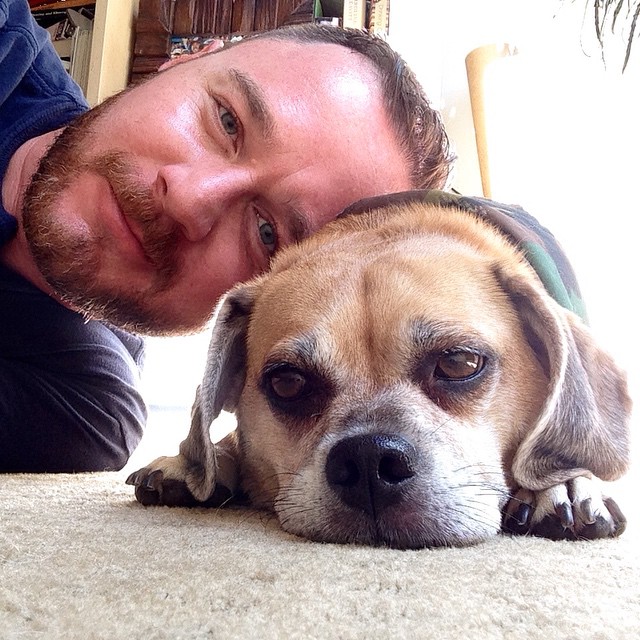 A dude (me) and his dog (Rocco). Finding mindfulness isn't like flipping a switch.
Most of us can’t simply will ourselves into a state of zen like a Tibetan monk—the modern age and our overactive minds simply won’t allow it. So I look to the outside world for help. Be it through nature, exercise, apps, travel, everyday choices, or habits, we can use all sorts of methods to nudge ourselves to a more present state. One significant piece of my own personal outside world is my dog, Rocco. To put it bluntly, I love him to death. He always makes me smile and helps me forget whatever worry has been overwhelming my mind on a given day. I was thinking about him, and the larger infatuation many of us have with our pets, and suddenly it dawned on me—my dog is another one of the ways I nudge myself, often subconsciously, to get out of my head and live in the present. My dog teaches me mindfulness. The connection we have to our pets is multi-layered. No doubt, they provide us with companionship, unconditional love, snuggles and a great way to connect to other similarly passionate pet people. But there’s a deeper attachment that goes beyond the obvious. I propose a new theory—that we’re fanatically attached to our pets because they constantly teach us an important lesson about ourselves. Our pets take us out of our complicated adult lives for a moment, and back to a more mindful time—a time of youthful exuberance, a time before we were corrupted by the modern distracted world. They remind us of how we were then, and as such, remind us to try and a be little more like that again—right now. My dog Rocco is possibly the most zen being I know. He doesn’t worry about the future, except perhaps starting around four o’clock in the afternoon, when he knows dinner is imminent. He doesn’t stress over the decisions he makes, for instance—choosing which sunbeam to sleep in. He doesn’t regret his mistakes, even after tearing apart one of his favorite toys. He’s always enthusiastic when I take him on his morning walk, even if he had to wait while I procrastinated on Facebook. He jumps for joy at every treat, even if he’d always rather have bacon. He accepts all the snuggles and love I give, not worried about what other thing he might be missing out on. He’s also a big part of my favorite trick to get more mindful—nature. I hike a few times a week. The trails provide me with a level of exercise that keeps me physically fit and a level of peace and beauty that keeps me mentally fit. I often take Rocco on these hikes, and rather than take away from the moment of zen the wild gives me, he adds a whole new layer of zen that only enhances the experience. The exuberance he displays when I untether his leash adds to the exuberance I feel when I untether from the stress of city life. His curiosity to explore a new landscape—the trees, shrubs, vistas, wildlife and of course smells—brings me to a more mindfully aware state that bleeds into the rest of my day, on the trail and off. His consistent desire to stay close to me as we hike brings me an understanding of uncorrupted loyalty that I can carry with me into the human relationships of my everyday life. As a hiking partner, not only is he good at keeping up with my pace, he’s good at setting the pace for a mindful existence. I could go on and on, but you get the point. Rocco is my little yogi zen master. He doesn’t tell me how to live my life, but instead, he provides an example of a simpler way to live. Obviously, not all dogs are the same, and maybe I’m just lucky to have such an interested and present pooch. But I do think most dogs, most cats (I grew up with many) and most pets in general, have all these qualities to some degree. And it’s for those reasons we’re so drawn to them. When I’m feeling down, angry, stressed or worried about the future, I can look at Rocco and see a better way—a more simple, honest, mindful way. Maybe this is one of the reasons I love him so much. We’re all complicated humans, so it’s unrealistic to expect to live our lives with the same sincerity as our pets. It’s the cross of self-awareness we have to bear as a species. But that doesn’t mean we can’t learn from our furry companions—that we can’t take a moment to be with them in the moment, or that we can’t take the smile they give us and carry it with us as we go about our convoluted day. In that way, our pets are giving us the gift of mindfulness all the time. It’s up to us if we choose to accept it. Never Say Never
10/22/2015
 End, or just another start? I don't believe in finites: that is, the use of words we use to profess an emotion or opinion we believe will never change.
I have a little trouble with the words "best" and "worst" because in reality our perspective and experience in life is always changing. It's always possible that something can be better or worse in the future than whatever's happening right now. Something I think is the best or worst ever, is really just the best or worst so far. But possibly my least favorite finite is "never." How can you, in all seriousness, say you'll never do this or never try that? Are you channeling a psychic that suddenly enables you to predict the future? Are you so rigid that you know even in 30 years time you'll never change your mind, your tastes won't evolve, your world won't expand. Whatever you think you'd never do is merely a product of where you are now, and the only way that now is the be all/end all, is if you die right this second... ... ... But you didn't die did you? You're still here, living another now. It's just a few seconds after the last now, but it's still a new now. You're a few seconds older and a few seconds wiser, and in any given second - in any given situation, conversation, or experience - your mind could change on any number of things. I don't pretend to know what I'll be like 30 years from now. I'll be me, of course, but I'll have 30 more years of life to draw on. 30 more years of trying new things. 30 more years of getting out of my comfort zone. 30 more years to change my mind. Today I could say I will never skydive. I'll never climb Mount Everest. I'll never eat durian fruit. I'll never visit Antarctica. All possible "nevers" for me. But what if somewhere down the line I change my mind? What if I hike Mount Whitney here in California and love it? So then I take on Denali in Alaska and really catch the climbing bug. Then, despite just watching the harrowing movie Everest where (spoiler alert) pretty much everyone dies, I decide my life goal is to stand at the highest peak on planet earth. What if a series of decisions I make alters my mind on this or any number of opinions I have about things I'd "never" do? Honestly, right now I can't see myself ever having a desire to climb Everest (take a deep breath, mom). I love hiking and I've already put together a list of mountains I want to climb, but I'm also risk averse and exceptionally uninterested in dying at a young age. Despite that, I still can't use the word "never" here, just like I can't ever use it anywhere. My thoughts on Everest are just my current opinion. I am well aware that many of my opinions will change over time, and this could be one of them. Rather than make bold statements of certainty, I choose to mindfully live in the present and fully acknowledge that each moment is another experience that alters my future. I can never know if anything really is a "never," so I choose to never say never again.  I love to make plans and I'm a bit of perfectionist. Sometimes these are great attributes, like when I need to plan a big trip with a hundred moving parts (and do so expertly, I might add). Sometimes though, my perfectionist streak drives me crazy, like when one or more of those hundred moving parts starts to move in the wrong direction.
Recently, I was lucky enough to go to New Zealand. I went to sojourn with my man who was there for work, which means I was there to keep him company during his off time but I also had free time to do my favorite thing in the world... explore. I was going to learn about kiwi and Maori culture, hike over green hillsides and through rainforests, visit one of the oldest national parks in the world, see volcanoes and glaciers, get new perspectives, write lots of blog posts, and hopefully meet a few hobbits. Boy did I have a ton of plans for this trip, but boy did life have other plans for me. And bare with me here, but boy am I glad life changed all my plans. Not because I enjoy it when all my efforts fly out the window and those plans suddenly change, and not because (spoiler alert) I enjoy being sick on the other side of the international date line, but because of the lesson in mindfulness the whole crazy experience gave me. As soon as I arrived in New Zealand I got sick. For those of you who know me, you know I was also just sick for 2 weeks in early September. Sick sick sicky sick. Being sick is always struggle to some degree, but being sick abroad was a struggle on a whole new level. Side note: I've been debating just how much I want to divulge on this. I don't make it a point to whine, at least publicly. I don't like to worry anyone or act needy, so I largely kept this under wraps. Aside from one semi-vague Instagram post, and texts with close friends, very few people knew I was sick out there. But I'm trying to use this all as a lesson, one I can learn from and then one I'll tell you about so you can hopefully learn from as well. If I'm going to do that I need to let down my guard and take down the walls of privacy and vanity. As you can imagine, I spent a lot of this time feeling frustrated - all my well thought out plans dashed, my normally active self tied to a hotel bed, my love of exploring new territories and cultures stymied, hopes of a "perfect trip" lost. But that frustration, like any difficult time, was also an opportunity. Difficulty presents us with a personal mindfulness challenge. It always boils down to a choice: let the disappointment of an international exploration opportunity lost overtake me with anger and regret, OR use it as an excuse to reconnect to mindfulness and then use/enjoy every moment I do have for all its worth. Through painstaking effort, I chose the later. When I felt well enough to go exploring for a bit, I made sure to soak in every last second of the experience. When my throat was calm enough to allow a proper dinner, I savored every bite, and let myself have a glass of wine or a beer because I was on vacation goshdarnit. When I was awake and aware I made myself ever present and shook the chains of distraction loose. Because of the illness, I knew I'd have fewer moments of enjoyment on my trip, so I mindfully dove into any moment in had with gusto. Suddenly my time became less about the limitations of being sick, and more about the joy to be found in the random moments. I can have a memorable time whether or not everything goes exactly the way I expect. I can make good use of my time even if plans fall through. I can have a totally new and unexpected adventure even when things don't line up as I'd hoped. I can be frustrated and angry that this trip didn't go the way I hoped it would go, or I can accept that it changed and make the most of it... roll with the punches, go with the flow. My attitude about it, about anything, is entirely up to me. So make plans, set expectations, and do your best work to make sure everything goes your way - lord knows I'll never stop doing that - but make sure one of your expectations is that it's possible none of your expectations will actually come true. Life will take you where it wants, you can fight and lament and whine and cry but the change in your path will often happen whether you like it or not. It's way better for your sanity to just accept it and go with the flow. What's Your Adventure?
9/29/2015
 "What is your adventure?"
My former boss and current mentor, the wildly astute Gigi Johnson, recently posed this question on Facebook. She's says that when she meets people now, she asks them about their adventure instead of asking "what do you do?" or "where are you from?" as her opening salvo. "How do you present your path when you meet people? Are you a name, job title, and city? Are you a noun, verb, or journey?" I love everything about this. For years I've held disdain for the requisite "what do you do?" interrogation, as if somehow your whole life story, everything that you are, can be boiled down to a job title. Maybe for some, what you do as a profession really is your whole life. But for most of us, I think it's only one small part of a much larger 3D puzzle that makes up each of our personal worlds. For me lately, the "what I do?" question has required a complicated response. As far as the basic question goes, what I "do" is nothing because I don't have a full-time job. I make some mind-numbing side money driving for Lyft, but that's not what I "do." What I do is my adventure. I write this blog. I travel as much as I can afford. I hike as often as my body will allow. I do yoga and meditate for my sanity. I volunteer for TreePeople in forest care and the Sierra Club in political advocacy. I’m looking into becoming a volunteer naturalist, leading nature walks for school children. I’ve even found some paid environmental educator training programs that would let me go live in the the Santa Monica Mountains and Channel Islands National Park for a time. In the grand scheme, my goal is to spend my time bettering my soul, so that when I do find something to "do" again (you know, a job), it will be the right thing to do -- something that allows me to follow my passion and enriches my mind. So another thing I do is apply to real and meaningful jobs with environmental organizations that should help me to find a real and meaningful life. Or rather, continue the real and meaningful life I'm attempting to lead. Hopefully what you do is something amazing, but hopefully your adventure means even more than that. What’s your adventure? Need vs. Want
9/17/2015
 Don't care how, I want it now! Most of the things we purchase in life can be categorized as either a "need" or a "want."
I need water. I need food. I need sleep. I need a roof over my head. Compared to, say... I want to drink wine. I want to eat cheeseburgers. I want a Tempurpedic sleep number bed. I want a Spanish style or mid-century in Silverlake with a pool, Jacuzzi, Meyer lemon trees, space for a sizable vegetable garden, and views of the Hollywood sign. But you can't always get what you want, or so they say. We live in a consumer wasteland of a civilization. The line between what we want and what is actually needed is more blurred than ever. Like Veruca Salt, we want the goose that lays the golden egg and a bean feast. Don't care how, we want it now. And that said, there's absolutely nothing wrong with buying things that make you happy, even if you don't really need them. Life's short and most of us aren’t living on a hippie commune. There's nothing wrong with a good "treat yo self" once in a while. You're worth it. For the last few years I've tried, and sometimes succeeded, in pausing for a moment to differentiate a need vs. a want when I'm deciding whether to buy something. To think about my motivation for buying something. It's never easy. I'm an Amazon Prime member, and the free two-day shipping along with generally cut rate prices leads to many temptations. Do I need the new sleeveless navy running shirt, or is that a want? Do I want the California flag luggage tag, or is that a need? Is it even worth my time considering the question or should I just get them both because they’ll make me happy? Those are both actual items I did and didn't purchase, and I still can't totally answer the need vs want question for them. Life isn’t black and white - it’s gray that way. One reason I enjoy camping so much is to test the limits of my internal need vs. want debate. When you strip off many of your daily comforts and live simply, plainly, unambiguously, need starts to hold a lot more weight than want. Storage space is limited, and you have to carry things back and forth from car to campsite, so you start to prioritize. The things you don’t need become clutter. Other items become requirements. Each time I’ve camped I’ve whittled my pack down, getting rid of the silly camping toys in order to save space and energy for the tools I actually need. I’m about ready to dabble in actual backpacking, carrying everything you need on your back, so this thought process will become that much more important. The difference between camping and our everyday life is, of course, quite stark. There’s a lot more room for wanted, but not needed, items in the modern world. But the lessons of simplicity you gain out in nature are still just as relevant. The task of thinking about what I need vs what I want helps me prioritize my life. It gives me a better appreciation for the things I already have, the things most of us have that make life easy, comfy, and fun. Beyond “things,” it helps me to better appreciate life, a lesson I hope to remember the next time I think my charmed existence is going so terribly that I literally can't even. When you’re about to buy something, think about it… is it a “need” or a “want?” Notice how that simple activity makes you see your world in a new light. |
Access Octomono Masonry Settings
blog searchauthorMy name is Jason Wise. Life's all about the journey, man. Find me on Instagram and Facebook. archives
May 2020
categories
All
subscribe |
